Free!
Pigsty OSS
But no Warranty
PG: 16
OS: 3 major distro
- EL 8.9
- Debian 12
- Ubuntu 22.04
Modules: Core Modules
SLA: Not Available
Community Support
Self-sufficient OSS Guru Developers
This is the multi-page printable view of this section. .
“PostgreSQL In Great STYle”: Postgres, Infras, Graphics, Service, Toolbox, it’s all Yours.
—— Battery-Included, Local-First PostgreSQL Distribution as an Open-Source RDS Alternative
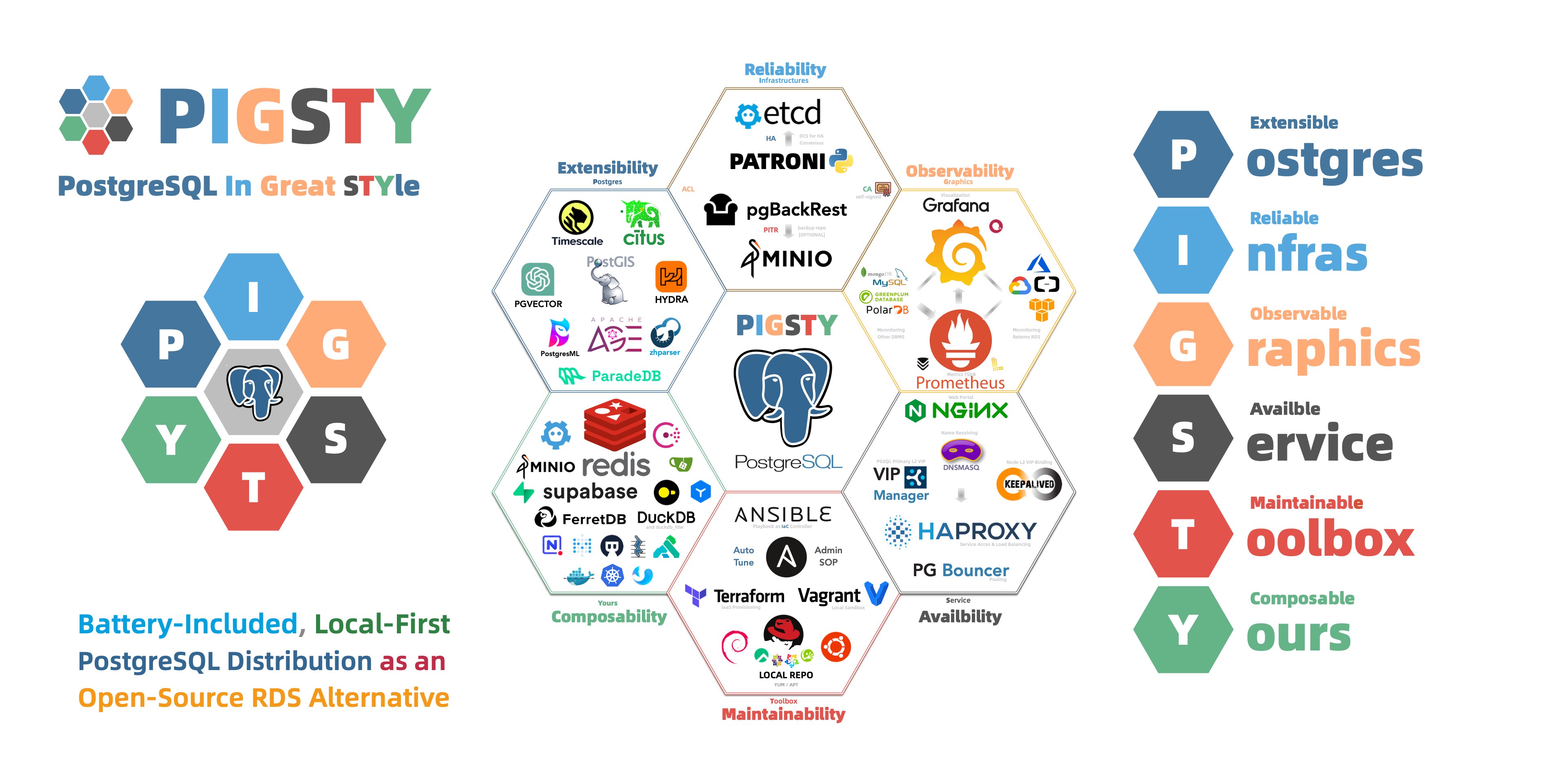
Pigsty is built-upon industry best practices:
Pigsty can be used in different scenarios:
pgvector and PostgresML.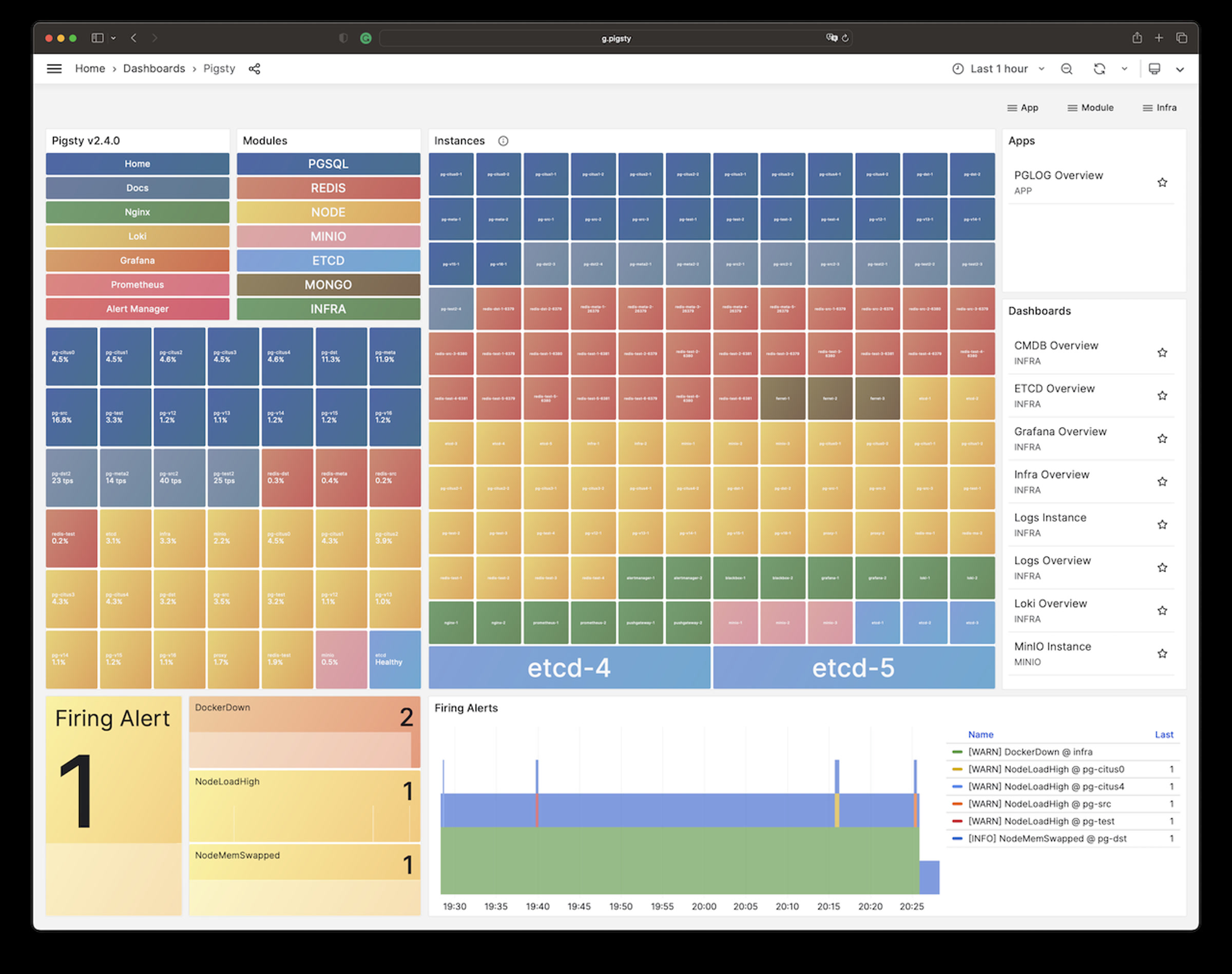
Run production-grade RDS for PostgreSQL on your own machine in 10 minutes!
While PostgreSQL shines as a database kernel, it excels as a Relational Database Service (RDS) with Pigsty’s touch.
Pigsty is compatible with PostgreSQL 12-16 and runs seamlessly on EL 7, 8, 9, Debian 11/12, Ubuntu 20/22 and similar OS distributions. It integrates the kernel with a rich set of extensions, provides all the essentials for a production-ready RDS, an entire set of infrastructure runtime coupled with fully automated deployment playbooks. With everything bundled for offline installation without internet connectivity.
You can transit from a fresh node to a production-ready state effortlessly, deploy a top-tier PostgreSQL RDS service in a mere 10 minutes. Pigsty will tune parameters to your hardware, handling everything from kernel, extensions, pooling, load balancing, high-availability, monitoring & logging, backups & PITR, security and more! All you need to do is run the command and connect with the given URL.
Harness the might of the most advanced Open-Source RDBMS or the world!
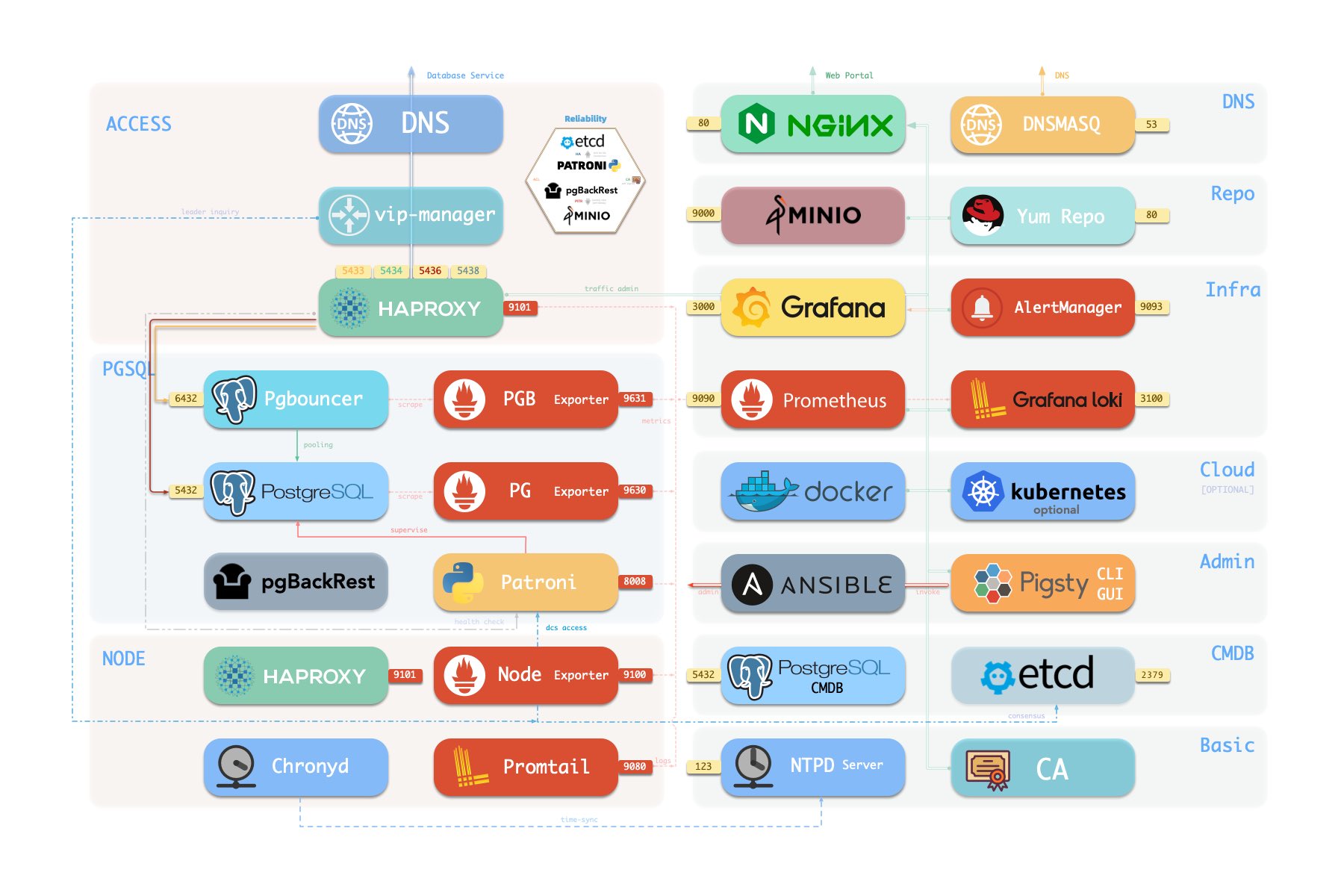
PostgreSQL’s has an unique extension ecosystem. Pigsty seamlessly integrates these powerful extensions, delivering turnkey distributed solutions for time-series, geospatial, and vector capabilities.
Pigsty boasts 255 PostgreSQL extensions, and maintaining some not found in official PGDG repositories. Rigorous testing ensures flawless integration for core extensions: Leverage PostGIS for geospatial data, TimescaleDB for time-series analysis, Citus for horizontal scale out, PGVector for AI embeddings, Apache AGE for graph data, ParadeDB for Full-Text Search, and Hydra, DuckdbFDW, pg_analytics for OLAP workloads!
You can also run self-hosted Supabase & PostgresML with Pigsty managed HA PostgreSQL. If you want to add your own extension, feel free to suggest or compile it by yourself.
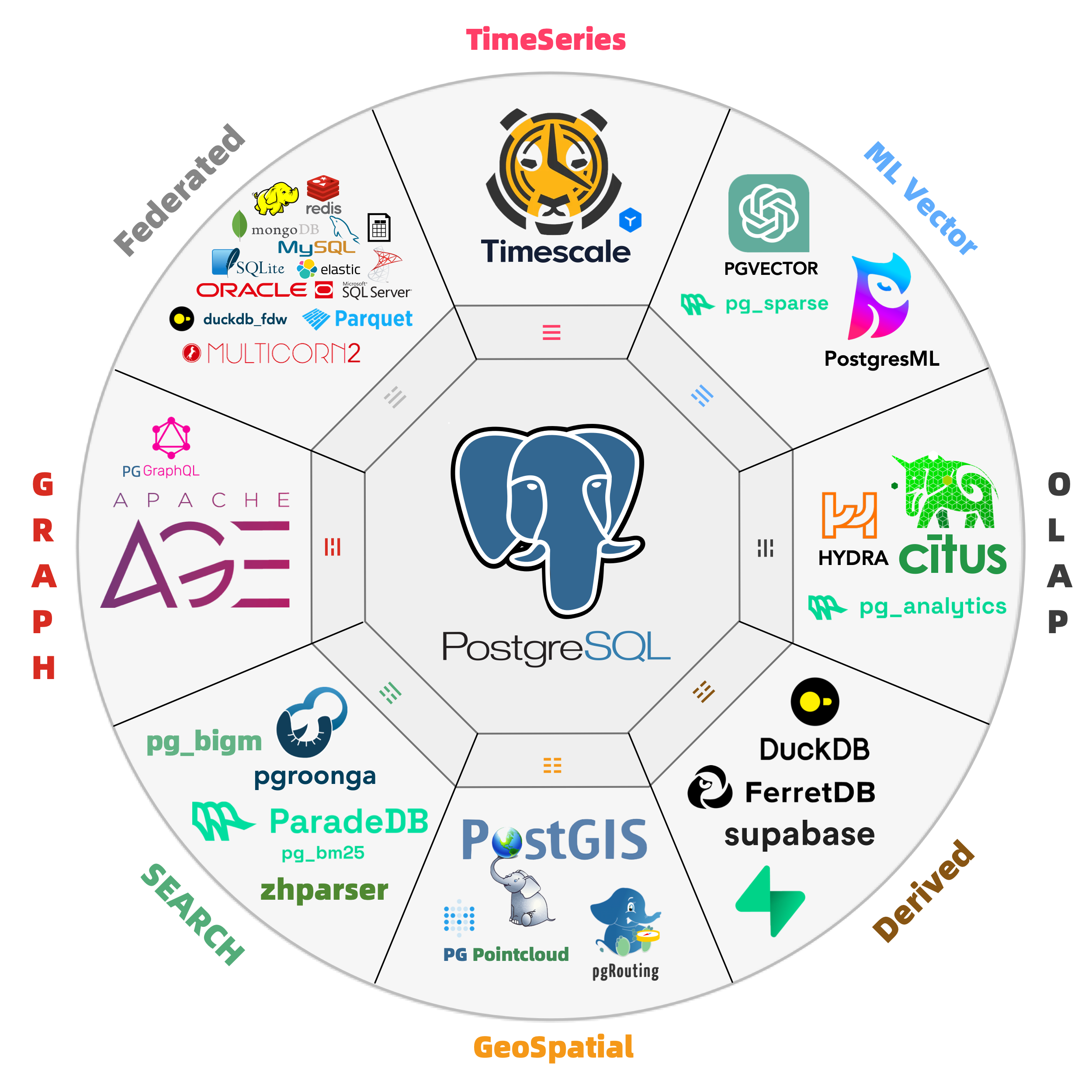
modular design, composable, Redis/MinIO/Etcd/Mongo support, and monitoring existing PG & RDS
All functionality is abstracted as Modules that can be freely composed for different scenarios.
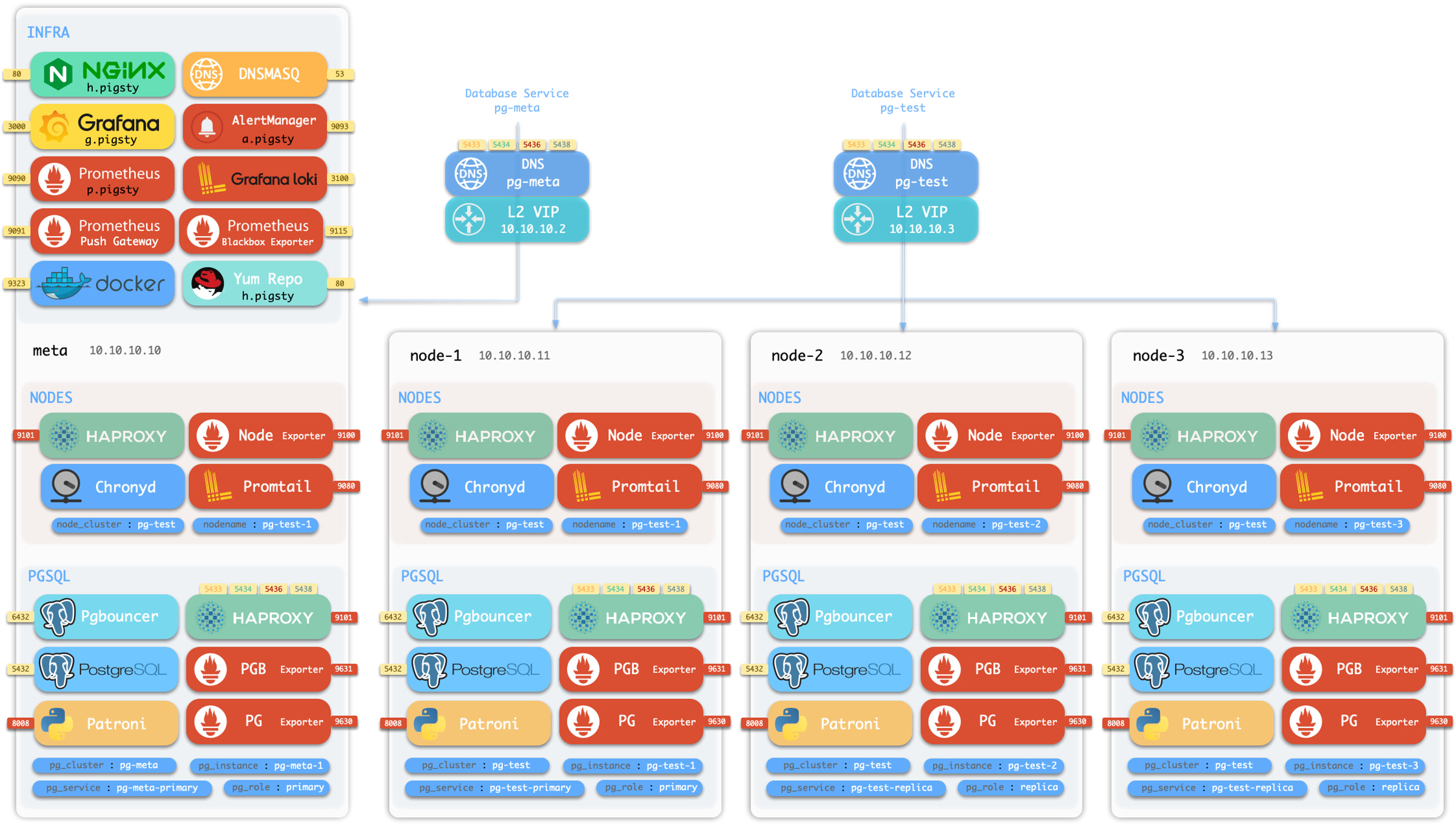
INFRA gives you a modern observability stack, while NODE can be used for host monitoring.
Installing the PGSQL module on multiple nodes will automatically form a HA cluster.
And you can also have dedicated ETCD clusters for distributed consensus & MinIO clusters for backup storage.
REDIS are also supported since they work well with PostgreSQL.
You can reuse Pigsty infra and extend it with your Modules (e.g. GPSQL, KAFKA, MONGO, MYSQL…).
Moreover, Pigsty’s INFRA module can be used alone — ideal for monitoring hosts, databases, or cloud RDS.
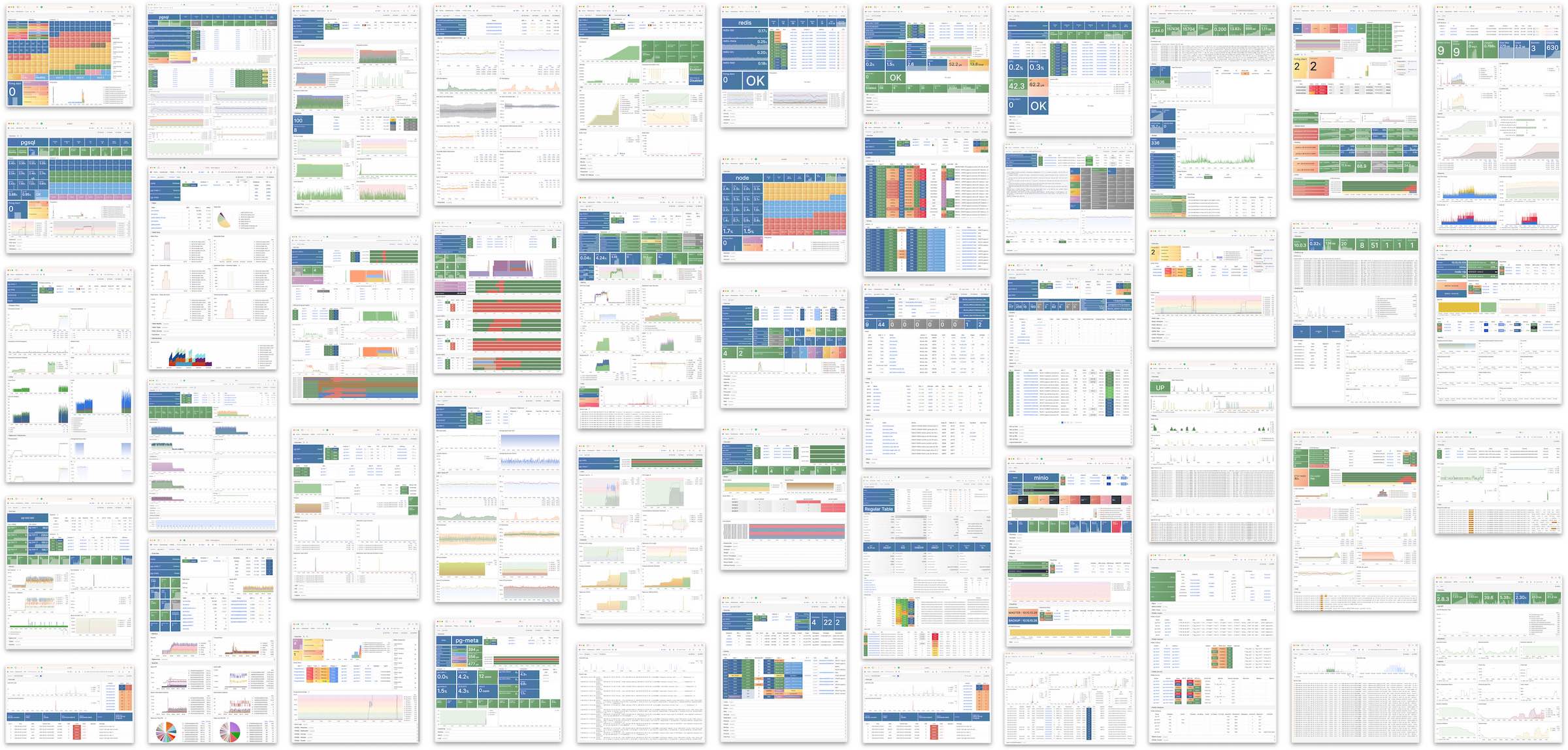
Unparalleled monitoring system based on modern observability stack and open-source best-practice!
Pigsty will automatically monitor any newly deployed components such as Node, Docker, HAProxy, Postgres, Patroni, Pgbouncer, Redis, Minio, and itself. There are 30+ default dashboards and pre-configured alerting rules, which will upgrade your system’s observability to a whole new level. Of course, it can be used as your application monitoring infrastructure too.
There are over 3K+ metrics that describe every aspect of your environment, from the topmost overview dashboard to a detailed table/index/func/seq. As a result, you can have complete insight into the past, present, and future.
Check the dashboard gallery and public demo for more details.
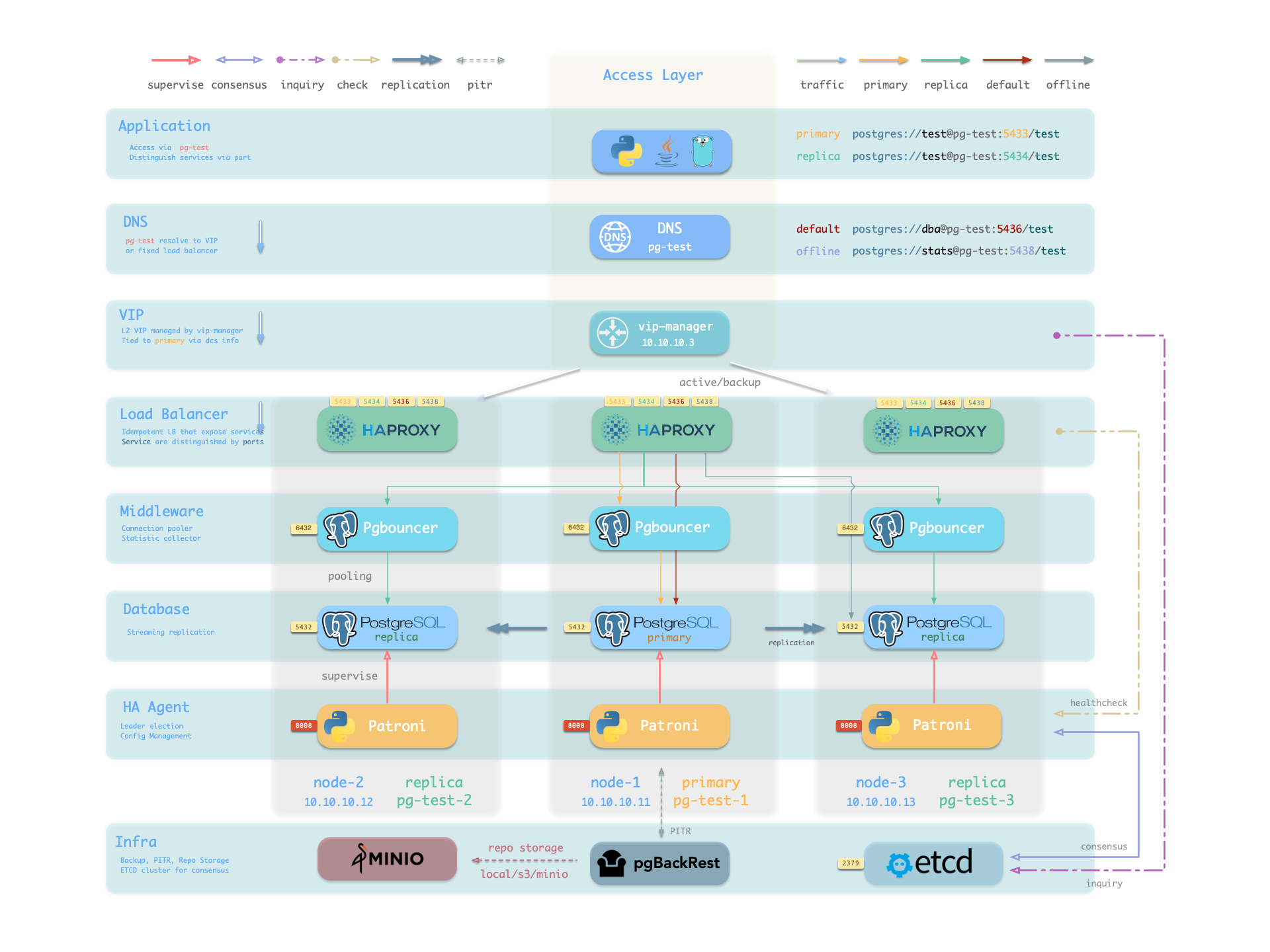
Pigsty has pre-configured HA & PITR for PostgreSQL to ensure your database service is always reliable.
Hardware failures are covered by self-healing HA architecture powered by patroni, etcd, and haproxy, which will perform auto failover in case of leader failure (RTO < 30s), and there will be no data loss (RPO = 0) in sync mode. Moreover, with the self-healing traffic control proxy, the client may not even notice a switchover/replica failure.
Software Failures, human errors, and Data Center Failures are covered with Cold backups & PITR, which are implemented with pgBackRest. It allows you to travel time to any point in your database’s history as long as your storage is capable. You can store them in the local backup disk, built-in MinIO cluster, or S3 service.
Large organizations have used Pigsty for several years. One of the largest deployments has 25K CPU cores and 220+ massive PostgreSQL instances. In the past three years, there have been dozens of hardware failures & incidents, but the overall availability remains several nines (99.999% +).
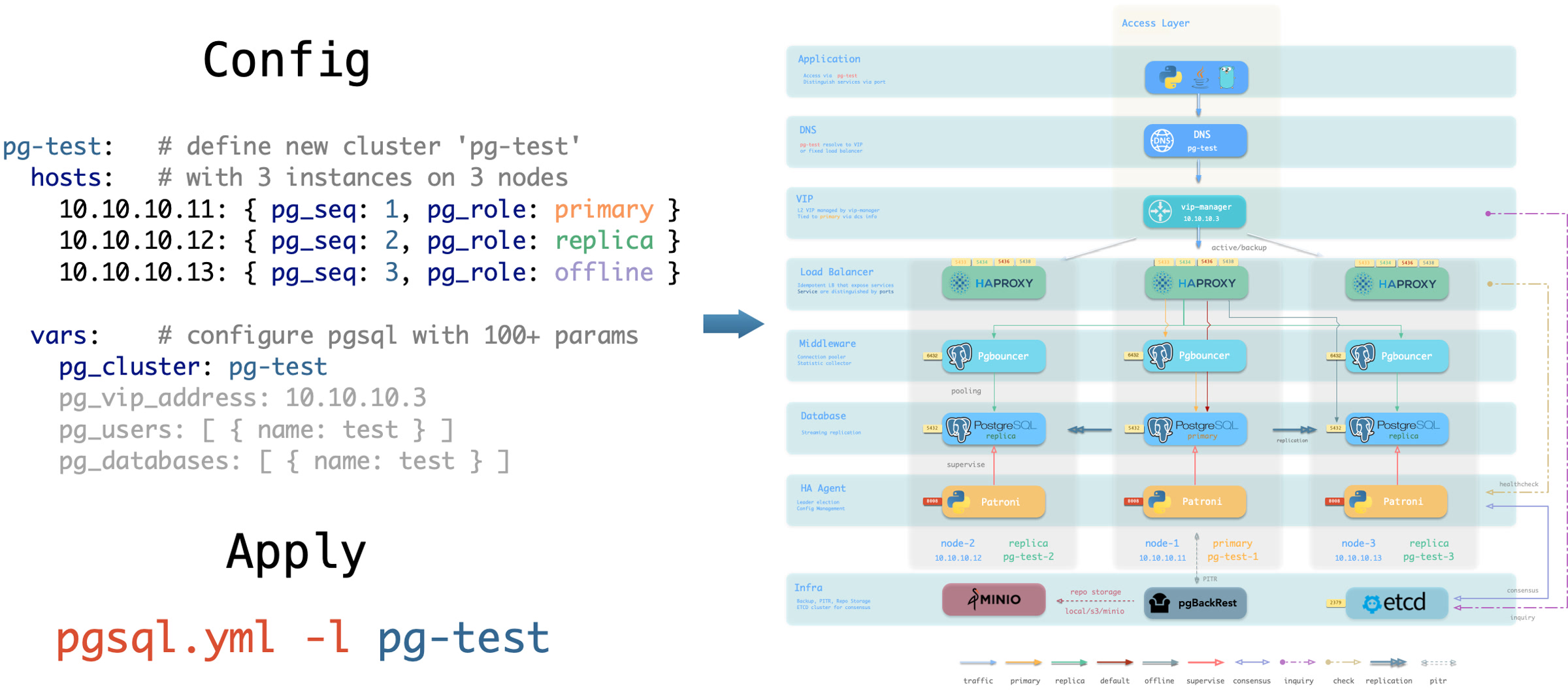
Infra as Code, Database as Code, Declarative API & Idempotent Playbooks, GitOPS works like a charm.
Pigsty provides a declarative interface: Describe everything in a config file, and Pigsty operates it to the desired state. It works like Kubernetes CRDs & Operators but for databases and infrastructures on any nodes: bare metal or virtual machines.
To create cluster/database/user/extension, expose services, or add replicas. All you need to do is to modify the cluster definition and run the idempotent playbook. Databases & Nodes are tuned automatically according to their hardware specs, and monitoring & alerting is pre-configured. As a result, database administration becomes much more manageable.
Pigsty has a full-featured sandbox powered by Vagrant, a pre-configured one or 4-node environment for testing & demonstration purposes. You can also provision required IaaS resources from cloud vendors with Terraform templates.
Nothing needs to be worried about database security, as long as your hardware & credentials are safe.
Pigsty use SSL for API & network traffic, Encryption for password & backups, HBA rules for host & clients, and access control for users & objects.
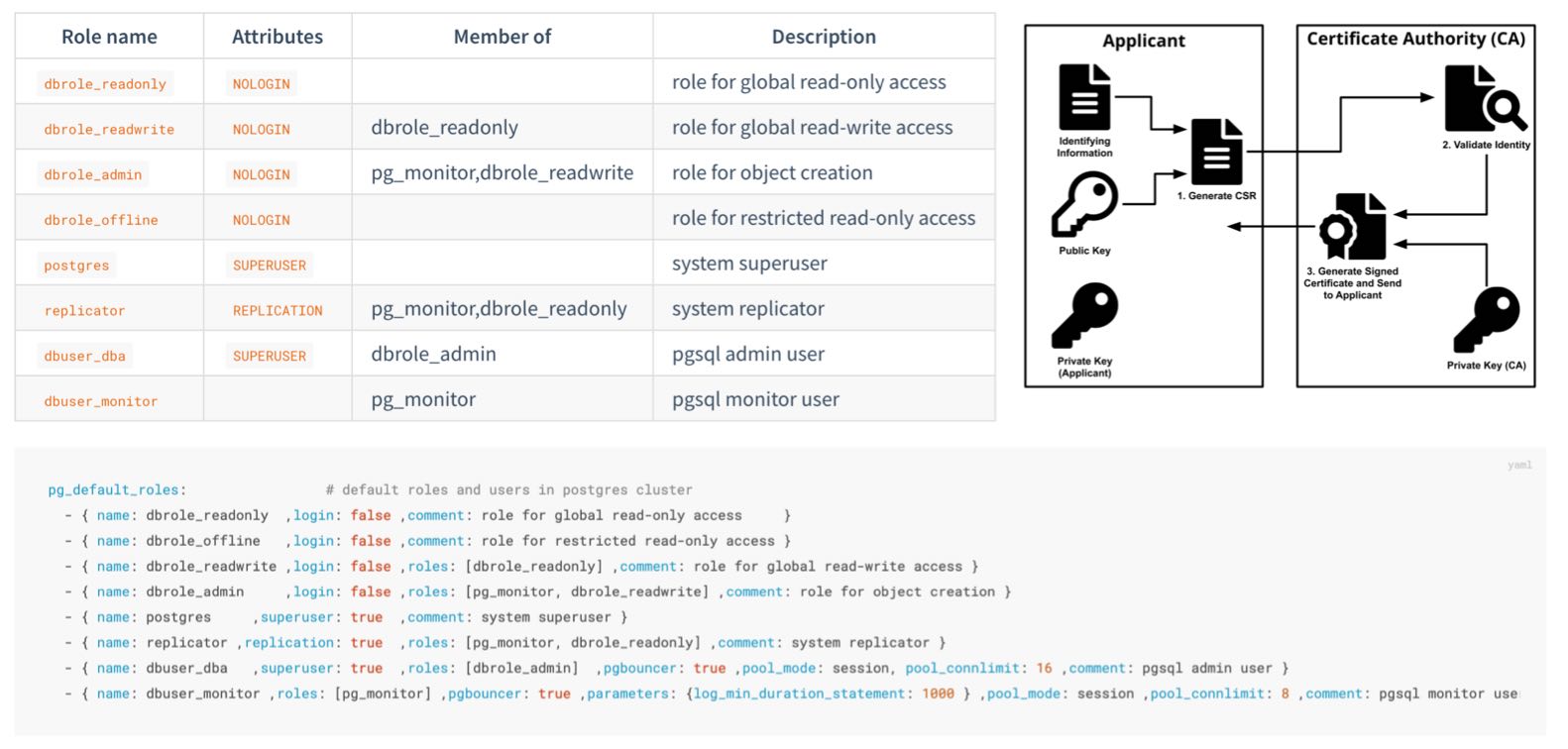
Pigsty has an easy-to-use, fine-grained, and fully customizable access control framework based on roles, privileges, and HBA rules. It has four default roles: read-only, read-write, admin (DDL), offline (ETL), and four default users: dbsu, replicator, monitor, and admin. Newly created database objects will have proper default privileges for those roles. And client access is restricted by a set of HBA rules that follows the least privilege principle.
Your entire network communication can be secured with SSL. Pigsty will automatically create a self-signed CA and issue certs for that. Database credentials are encrypted with the scram-sha-256 algorithm, and cold backups are encrypted with the AES-256 algorithm when using MinIO/S3. Admin Pages and dangerous APIs are protected with HTTPS, and access is restricted from specific admin/infra nodes.
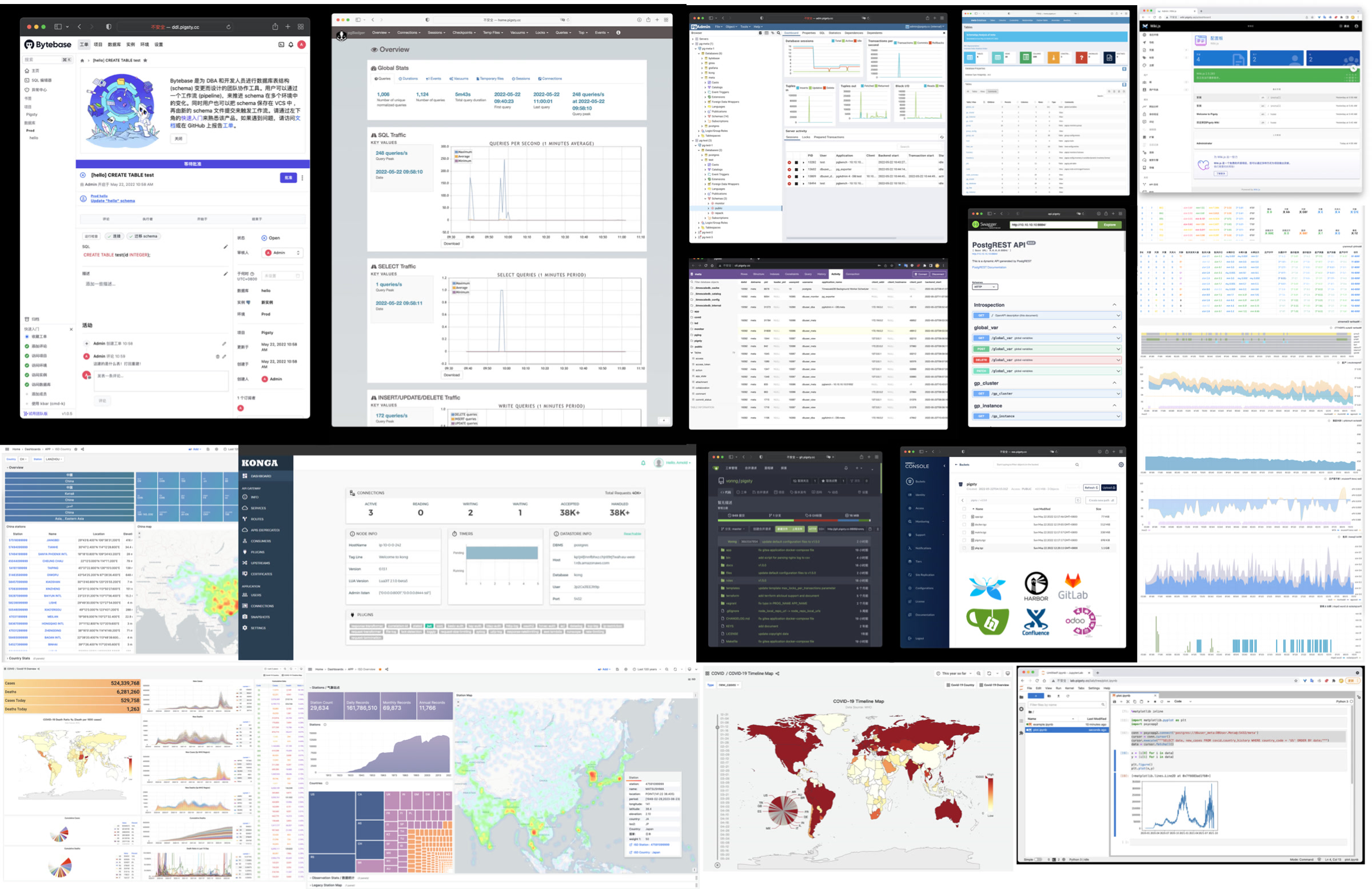
Lots of applications work well with PostgreSQL. Run them in one command with docker.
The database is usually the most tricky part of most software. Since Pigsty already provides the RDS. It could be nice to have a series of docker templates to run software in stateless mode and persist their data with Pigsty-managed HA PostgreSQL (or Redis, MinIO), including Gitlab, Gitea, Wiki.js, NocoDB, Odoo, Jira, Confluence, Harbour, Mastodon, Discourse, and KeyCloak.
Pigsty also provides a toolset to help you manage your database and build data applications in a low-code fashion: PGAdmin4, PGWeb, ByteBase, PostgREST, Kong, and higher “Database” that use Postgres as underlying storage, such as EdgeDB, FerretDB, and Supabase. And since you already have Grafana & Postgres, You can quickly make an interactive data application demo with them. In addition, advanced visualization can be achieved with the built-in ECharts panel.
Pigsty is a free & open source software under AGPLv3. It was built for PostgreSQL with love.
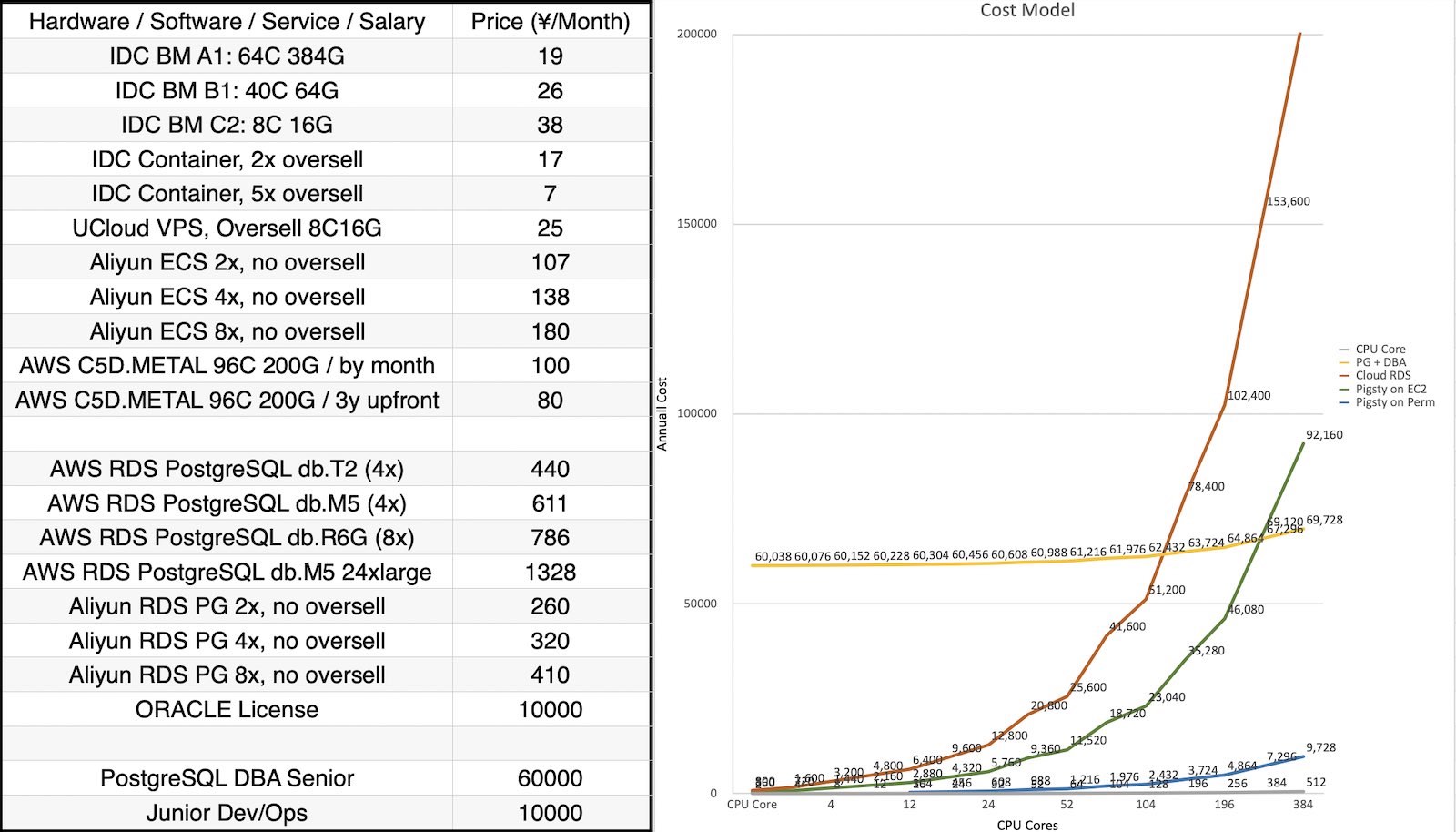
Pigsty allows you to run production-grade RDS on your hardware without suffering from human resources. As a result, you can achieve the same or even better reliability & performance & maintainability with only 5% ~ 40% cost compared to Cloud RDS PG. As a result, you may have an RDS with a lower price even than ECS.
There will be no vendor lock-in, annoying license fee, and node/CPU/core limit. You can have as many RDS as possible and run them as long as possible. All your data belongs to you and is under your control.
Pigsty is free software under AGPLv3. It’s free of charge, but beware that freedom is not free, so use it at your own risk! It’s not very difficult, and we are glad to help. For those enterprise users who seek professional consulting services, we do have a subscription for that.
Pigsty offers four CORE modules, which are essential for providing PostgreSQL service:
PGSQL : An autonomous, highly available PostgreSQL cluster powered by Patroni, Pgbouncer, HAproxy, PgBackrest, and others.INFRA : Local software repository, Prometheus, Grafana, Loki, AlertManager, PushGateway, Blackbox Exporter, etc.NODE : Adjusts the node to the desired state, name, time zone, NTP, ssh, sudo, haproxy, docker, promtail, keepalived.ETCD : Distributed key-value store, serving as the DCS (Distributed Consensus System) for the highly available Postgres cluster: consensus leadership election, configuration management, service discovery.Pigsty offers four OPTIONAL modules,which are not necessary for the core functionality but can enhance the capabilities of PostgreSQL:
MINIO: S3-compatible simple object storage server, serving as an optional PostgreSQL database backup repository with production deployment support and monitoring.REDIS: Redis server, a high-performance data structure server supporting standalone master-slave, sentinel, and cluster mode production deployments, with comprehensive monitoring support.MONGO: Native deployment support for FerertDB — adding MongoDB wire protocol level API compatibility to PostgreSQL!DOCKER: Docker Daemon service, allowing users to easily deploy containerized stateless software tool templates, adding various functionalities.Pigsty includes some pilot and planned functional modules. If you’re interested, you may consider trying them out and providing us with suggestions and feedback:
DUCK: Pigsty by default includes DuckDB in the offline software package, offering powerful standalone embedded analytics capabilities (Beta).CLOUD:Pigsty plans to use SealOS to provide out-of-the-box production-grade Kubernetes deployment and monitoring support (Beta).MYSQL:Pigsty is researching adding high-availability deployment support for MySQL as an optional extension feature (Alpha).GPSQL:Pigsty plans to support production-level deployment of Greenplum (Alpha).KAFKA:Pigsty plans to offer message queue support (Draft).Pigsty also provides some services that can be quickly deployed through the DOCKER module, such as various second-order “databases” that use PostgreSQL as the actual state storage:
Supabase: An open-source alternative to Firebase based on PostgreSQL. Pigsty provides the necessary extensions in EL series operating systems to allow you to quickly set up Supabase.FerretDB: An open-source MongoDB alternative based on PostgreSQL. You can quickly deploy containerized FerretDB using Docker Compose.NocoDB: An open-source AirTable alternative based on PostgreSQL, offering low-code application development capabilities. If you need a Web Excel, consider using NocoDB.Metabase: Enables quick in-database data analysis with a friendly web interface toolbox. When you need to explore data in PostgreSQL, consider using Metabase.Pigsty’s INFRA module can be used independently as a plug-and-play monitoring infrastructure for other nodes or existing PostgreSQL databases:
RDS PG: Cloud vendor-provided PostgreSQL RDS services, treated as standard external Postgres instances for monitoring.PolarDB: Alibaba Cloud’s cloud-native database, treated as an external PostgreSQL 11 / 14 instance for monitoring.KingBase: A trusted domestic database provided by People’s University of China, treated as an external PostgreSQL 12 instance for monitoring.Greenplum / YMatrixDB monitoring, currently treated as horizontally partitioned PostgreSQL clusters for monitoring.Moreover, Pigsty is planning to support monitoring other types of database systems:
MySQL: Pigsty currently offers preliminary support for MySQL monitoring (Alpha).Kafka: Pigsty plans to provide monitoring support for Kafka (planned).MongoDB: Pigsty plans to provide monitoring support for MongoDB (planned).Pigsty employs semantic versioning, denoted as <major version>.<minor version>.<patch>. Alpha/Beta/RC versions are indicated with a suffix, such as -a1, -b1, -rc1.
Major updates signify foundational changes and a plethora of new features; minor updates typically introduce new features, software package version updates, and minor API changes, while patch updates are meant for bug fixes and documentation improvements.
Pigsty plans to release a major update annually, with minor updates usually following the rhythm of PostgreSQL minor releases, aiming to catch up within a month after a new PostgreSQL version is released, typically resulting in 4 - 6 minor updates annually. For a complete release history, refer to Release Notes.
Please always use a version-specific release, do not use the GitHub master branch unless you know what you are doing.
The Pigsty project kicked off between 2018 and 2019, originating from Tantan, a dating app akin to China’s Tinder, now acquired by Momo. Tantan, a startup with a Nordic vibe, was founded by a team of Swedish engineers. Renowned for their tech sophistication, they chose PostgreSQL and Go as their core tech stack. Tantan’s architecture, inspired by Instagram, revolves around PostgreSQL. They managed to scale to millions of daily active users, millions of TPS, and hundreds of TBs of data using PostgreSQL exclusively. Almost all business logic was implemented using PG stored procedures, including recommendation algorithms with 100ms latency!
This unconventional development approach, deeply leveraging PostgreSQL features, demanded exceptional engineering and DBA skills. Pigsty emerged from these real-world, high-standard database cluster scenarios as an open-source project encapsulating our top-tier PostgreSQL expertise and best practices.
Initially, Pigsty didn’t have the vision, objectives, or scope it has today. It was meant to be a PostgreSQL monitoring system for our use. After evaluating every available option—open-source, commercial, cloud-based, datadog, pgwatch,…… none met our observability bar. So, we took matters into our own hands, creating a system based on Grafana and Prometheus, which became the precursor to Pigsty. As a monitoring system, it was remarkably effective, solving countless management issues.
Eventually, developers wanted the same monitoring capabilities on their local dev machines. We used Ansible to write provisioning scripts, transitioning from a one-off setup to a reusable software. New features allowed users to quickly set up local DevBoxes or production servers with Vagrant and Terraform, automating PostgreSQL and monitoring system deployment through Infra as Code.
We then redesigned the production PostgreSQL architecture, introducing Patroni and pgBackRest for high availability and point-in-time recovery. We developed a zero-downtime migration strategy based on logical replication, performing rolling updates across 200 database clusters to the latest major version using blue-green deployments. These capabilities were integrated into Pigsty.
Pigsty, built for our use, reflects our understanding of our needs, avoiding shortcuts. The greatest benefit of “eating our own dog food” is being both developers and users, deeply understanding and not compromising on our requirements.
We tackled one problem after another, incorporating solutions into Pigsty. Its role evolved from a monitoring system to a ready-to-use PostgreSQL distribution. At this stage, we decided to open-source Pigsty, initiating a series of technical talks and promotions, attracting feedback from users across various industries.
In 2022, Pigsty secured seed funding from Dr. Qi’s MiraclePlus S22 (Former YC China), enabling me to work on it full-time. As an open-source project, Pigsty has thrived. In the two years since going full-time, its GitHub stars skyrocketed from a few hundred to 2400, On OSSRank, Pigsty ranks 37th among PostgreSQL ecosystem projects.
Originally only compatible with CentOS7, Pigsty now supports all major Linux Distors and PostgreSQL versions 12 - 16, integrating 255 extensions from the ecosystem. I’ve personally compiled, packaged, and maintained some extensions not found in official PGDG repositories.
Pigsty’s identity has evolved from a PostgreSQL distribution to an open-source cloud database alternative, directly competing with entire cloud database services offered by cloud providers.
Public cloud vendors like AWS, Azure, GCP, and Aliyun offer many conveniences to startups but are proprietary and lock users into high-cost infra rentals.
We believe that top-notch database services should be as accessible same as top-notch database kernel (PostgreSQL), not confined to costly rentals from cyber lords.
Cloud agility and elasticity are great, but it should be open-source, local-first and cheap enough. We envision a cloud computing universe with an open-source solution, returning the control to users without sacrificing the benefits of the cloud.
Thus, we’re leading the “cloud-exit” movement in China, rebelling against public cloud norms to reshape industry values.
We’d like to see a world where everyone has the factual right to use top services freely, not just view the world from the pens provided by a few public cloud providers.
This is what Pigsty aims to achieve —— a superior, open-source, free RDS alternative. Enabling users to deploy a database service better than cloud RDS with just one click, anywhere (including on cloud servers).
Pigsty is a comprehensive enhancement for PostgreSQL and a spicy satire on cloud RDS. We offer “the Simple Data Stack”, which consists of PostgreSQL, Redis, MinIO, and more optional modules.
Pigsty is entirely open-source and free, sustained through consulting and sponsorship. A well-built system might run for years without issues, but when database problems arise, they’re serious. Often, expert advice can turn a dire situation around, and we offer such services to clients in need—a fairer and more rational model.
I’m Feng Ruohang, the creator of Pigsty. I’ve developed most of Pigsty’s code solo, with the community contributing specific features.
Unique individuals create unique works —— I hope Pigsty can be one of those creations.
If you are interested in the author, here’s my personal website: https://vonng.com/en/
Pigsty v2.7 Released!
Pigsty v2.6 Released!
The name of this project always makes me grin: PIGSTY is actually an acronym, standing for Postgres In Great STYle! It’s a Postgres distribution that includes lots of components and tools out of the box in areas like availability, deployment, and observability. The latest release pushes everything up to Postgres 16.2 standards and introduces new ParadeDB and DuckDB FDW extensions.
| Version | Time | Description | Release |
|---|---|---|---|
| v2.7.0 | 2024-05-20 | Extension Overwhelming, new docker apps | v2.7.0 |
| v2.6.0 | 2024-02-28 | PG 16 as default version, ParadeDB & DuckDB | v2.6.0 |
| v2.5.1 | 2023-12-01 | Routine update, pg16 major extensions | v2.5.1 |
| v2.5.0 | 2023-10-24 | Ubuntu/Debian Support: bullseye, bookworm, jammy, focal | v2.5.0 |
| v2.4.1 | 2023-09-24 | Supabase/PostgresML support, graphql, jwt, pg_net, vault | v2.4.1 |
| v2.4.0 | 2023-09-14 | PG16, RDS Monitor, New Extensions | v2.4.0 |
| v2.3.1 | 2023-09-01 | PGVector with HNSW, PG16 RC1, Chinese Docs, Bug Fix | v2.3.1 |
| v2.3.0 | 2023-08-20 | PGSQL/REDIS Update, NODE VIP, Mongo/FerretDB, MYSQL Stub | v2.3.0 |
| v2.2.0 | 2023-08-04 | Dashboard & Provision overhaul, UOS compatibility | v2.2.0 |
| v2.1.0 | 2023-06-10 | PostgreSQL 12 ~ 16beta support | v2.1.0 |
| v2.0.2 | 2023-03-31 | Add pgvector support and fix MinIO CVE | v2.0.2 |
| v2.0.1 | 2023-03-21 | v2 Bug Fix, security enhance and bump grafana version | v2.0.1 |
| v2.0.0 | 2023-02-28 | Compatibility Security Maintainability Enhancement | v2.0.0 |
| v1.5.1 | 2022-06-18 | Grafana Security Hotfix | v1.5.1 |
| v1.5.0 | 2022-05-31 | Docker Applications | v1.5.0 |
| v1.4.1 | 2022-04-20 | Bug fix & Full translation of English documents. | v1.4.1 |
| v1.4.0 | 2022-03-31 | MatrixDB Support, Separated INFRA, NODES, PGSQL, REDIS | v1.4.0 |
| v1.3.0 | 2021-11-30 | PGCAT Overhaul & PGSQL Enhancement & Redis Support Beta | v1.3.0 |
| v1.2.0 | 2021-11-03 | Upgrade default Postgres to 14, monitoring existing pg | v1.2.0 |
| v1.1.0 | 2021-10-12 | HomePage, JupyterLab, PGWEB, Pev2 & Pgbadger | v1.1.0 |
| v1.0.0 | 2021-07-26 | v1 GA, Monitoring System Overhaul | v1.0.0 |
| v0.9.0 | 2021-04-04 | Pigsty GUI, CLI, Logging Integration | v0.9.0 |
| v0.8.0 | 2021-03-28 | Service Provision | v0.8.0 |
| v0.7.0 | 2021-03-01 | Monitor only deployment | v0.7.0 |
| v0.6.0 | 2021-02-19 | Architecture Enhancement | v0.6.0 |
| v0.5.0 | 2021-01-07 | Database Customize Template | v0.5.0 |
| v0.4.0 | 2020-12-14 | PostgreSQL 13 Support, Official Documentation | v0.4.0 |
| v0.3.0 | 2020-10-22 | Provisioning Solution GA | v0.3.0 |
| v0.2.0 | 2020-07-10 | PGSQL Monitoring v6 GA | v0.2.0 |
| v0.1.0 | 2020-06-20 | Validation on Testing Environment | v0.1.0 |
| v0.0.5 | 2020-08-19 | Offline Installation Mode | v0.0.5 |
| v0.0.4 | 2020-07-27 | Refactor playbooks into ansible roles | v0.0.4 |
| v0.0.3 | 2020-06-22 | Interface enhancement | v0.0.3 |
| v0.0.2 | 2020-04-30 | First Commit | v0.0.2 |
| v0.0.1 | 2019-05-15 | POC | v0.0.1 |
| Date | Type | Event | Topic |
|---|---|---|---|
| 2023-12-20 | Live Debate | Open Source Musings, Episode 7 | Cloud Up or Down, Harvesting Users or Reducing Costs? |
| 2023-11-24 | Tech Conference | Vector Databases in the Era of Large Models | Roundtable Discussion: The New Future of Vector Databases in the Era of Large Models |
| 2023-09-08 | Exclusive Interview | Motianlun Notable Figures Interview | Feng Ruohang: A Tech Fanatic Who Doesn’t Want to Be Just a Meme Maker Isn’t a Good Open Source Founder |
| 2023-08-16 | Tech Conference | DTCC 2023 | DBA Night: The Open Source Licensing Issue of PostgreSQL vs MySQL |
| 2023-08-09 | Live Debate | Open Source Musings, Episode 1 | MySQL vs PostgreSQL, Who is the World’s Number One? |
| 2023-07-01 | Tech Conference | SACC 2023 | Workshop 8: FinOps Practices: Cloud Cost Management and Optimization |
| 2023-05-12 | Offline Event | PostgreSQL China Community Wenzhou Offline Salon | PG With DB4AI: Vector Database PGVECTOR & AI4DB: Autonomous Driving Database Pigsty |
| 2023-04-08 | Tech Conference | Database Carnival 2023 | A Better Open Source RDS Alternative: Pigsty |
| 2023-04-01 | Tech Conference | PostgreSQL China Community Xi’an Offline Salon | Best Practices for High Availability and Disaster Recovery in PG |
| 2023-03-23 | Public Livestream | Bytebase x Pigsty | Best Practices for Managing PostgreSQL: Bytebase x Pigsty |
| 2023-03-04 | Tech Conference | PostgreSQL China Tech Conference | Bombarding RDS, Release of Pigsty v2.0 |
| 2023-02-01 | Tech Conference | DTCC 2022 | Open Source RDS Alternatives: Out-of-the-Box, Self-Driving Database Edition Pigsty |
| 2022-07-21 | Live Debate | Can Open Source Fight Back Against Cloud Cannibalization? | Can Open Source Fight Back Against Cloud Cannibalization? |
| 2022-07-04 | Exclusive Interview | Creators Speak | Post-90s, Quitting Job to Entrepreneur, Aiming to Outperform Cloud Databases |
| 2022-06-28 | Public Livestream | Beth’s Roundtable | SQL Review Best Practices |
| 2022-06-12 | Public Roadshow | MiraclePlus S22 Demo Day | Cost-Effective Database Edition Pigsty |
| 2022-06-05 | Video Livestream | PG Chinese Community Livestream Sharing | Quick Start with New Features of Pigstyv1.5 & Building Production Clusters |
The Pigsty community already offers free WeChat/Discord/Telegram Q&A Office Hours, and we are also happy to provide more free value-added services to our supporters.
Our GitHub Repo: https://github.com/Vonng/pigsty , welcome to watch and star us.
Everyone is very welcome to submit new Issue or create Pull Request, propose feature suggestions and participate in Pigsty contribution.
Beware that for Pigsty documentation issues, please submit Issue in the github.com/Vonng/pigsty.cc repository.
Telegram: https://t.me/joinchat/gV9zfZraNPM3YjFh
Discord: https://discord.gg/j5pG8qfKxU
WeChat: Search pigsty-cc and join the User Group.

We have a GPTs for Pigsty documentation QA: https://chat.openai.com/g/g-y0USNfoXJ-pigsty-consul
You can also contact me with email: [email protected]
When having troubles with pigsty. You can ask the community for help, with enough info & context, here’s a template:
What happened? (REQUIRED)
Pigsty Version & OS Version (REQUIRED)
If you are using a cloud provider, please tell us which cloud provider and what operating system image you are using.
If you have customized and modified the environment after installing the bare OS, or have specific security rules and firewall configurations in your WAN, please also tell us when troubleshooting.
Pigsty Config File (REQUIRED)
Don’t forget to remove sensitive information like passwords, etc…
What did you expect to happen?
Please describe what you expected to happen.
How to reproduce it?
Please tell us as much detail as possible about how to reproduce the problem.
Monitoring Screenshots
If you are using pigsty monitoring system, you can paste RELEVANT screenshots here.
Error Log
Please copy and paste any RELEVANT log output. Do not paste something like “Failed to start xxx service”
/var/log/messages (rhel) or /var/log/syslog (debian)/pg/log/postgres/*/pg/log/patroni/*/pg/log/pgbouncer/*/pg/log/pgbackrest/*Have you tried the Issue & FAQ?
Anything else we need to know?
The more information and context you provide, the more likely we are to be able to help you solve the problem.
Pigsty is open sourced under the AGPLv3 license, which is a copyleft license.
Pigsty use the AGPLv3 license, which is a strong copyleft license that requires you to also distribute the source code of your derivative works under the same license. If you distribute Pigsty, you must make the source code available under the same license, and you must make it clear that the source code is available.
Permissions:
Limitations:
Conditions:
Beware that the Pigsty official website is also open sourced under CC by 4.0 license.
While employing the AGPLv3 license for Pigsty, we extend exemptions to common end users under terms akin to the Apache 2.0 license. Common end users are defined as all entities except public cloud and database service vendors.
These users may utilize Pigsty for commercial activities and service provision without licensing concerns. Our subscription include written guarantees of these terms for additional assurance.
We encourage cloud & databases vendors adhering to AGPLv3 to use Pigsty for derivative works and to contribute to the community.
Related software and open source project:
| Module | Software Name | License |
|---|---|---|
| PGSQL | PostgreSQL | PostgreSQL License (BSD-Like) |
| PGSQL | pgbouncer | ISC License |
| PGSQL | patroni | MIT License |
| PGSQL | pgbackrest | MIT License |
| PGSQL | vip-manager | BSD 2-Clause License |
| PGSQL | pg_exporter | Apache License 2.0 |
| NODE | node_exporter | Apache License 2.0 |
| NODE | haproxy | HAPROXY’s License (GPLv2) |
| NODE | keepalived | MIT License |
| INFRA | Grafana, Loki | GNU Affero General Public License v3.0 |
| INFRA | Prometheus | Apache License 2.0 |
| INFRA | DNSMASQ | GPLv2 / GPLv3 |
| INFRA | Ansible | GNU General Public License v3.0 |
| ETCD | etcd | Apache License 2.0 |
| MINIO | MinIO | GNU Affero General Public License v3.0 |
| REDIS | Redis | Redis License (3-clause BSD) |
| REDIS | Redis Exporter | MIT License |
| MONGO | FerretDB | Apache License 2.0 |
| DOCKER | docker-ce | Apache License 2.0 |
| CLOUD | Sealos | Apache License 2.0 |
| DUCKDB | DuckDB | MIT |
| External | Vagrant | Business Source License 1.1 |
| External | Terraform | Business Source License 1.1 |
| External | Virtualbox | GPLv2 |
PostgreSQL Extensions:
Pigsty is funded by MiraclePlus (formal YC China), S22 Batch.
Thanks to MiraclePlus and Dr.Qi’s support.
Pigsty is a free & open-source software nurtured by the passion of PostgreSQL community members.
If our work has helped you, please consider sponsoring or supporting our project. Every penny counts, and advertisements are also a form of support:
When you install the Pigsty software, if you use offline packages in a network-isolated environment, we will not receive any data about you.
If you choose to install online, then when downloading relevant software packages, our server or the servers of our cloud providers will automatically log the visiting machine’s IP address and/or hostname, as well as the name of the software package you downloaded, in the logs.
We will not share this information with other organizations unless legally required to do so.
The domain name used by Pigsty is: pigsty.io
When you visit our website, our servers automatically log your IP address and/or host name.
We store information such as your email address, name and locality only if you decide to send us such information by completing a survey, or registering as a user on one of our sites
We collect this information to help us improve the content of our sites, customize the layout of our web pages and to contact people for technical and support purposes. We will not share your email address with other organisations unless required by law.
This website uses Google Analytics, a web analytics service provided by Google, Inc. (“Google”). Google Analytics uses “cookies”, which are text files placed on your computer, to help the website analyze how users use the site.
The information generated by the cookie about your use of the website (including your IP address) will be transmitted to and stored by Google on servers in the United States. Google will use this information for the purpose of evaluating your use of the website, compiling reports on website activity for website operators and providing other services relating to website activity and internet usage. Google may also transfer this information to third parties where required to do so by law, or where such third parties process the information on Google’s behalf. Google will not associate your IP address with any other data held by Google. You may refuse the use of cookies by selecting the appropriate settings on your browser, however please note that if you do this you may not be able to use the full functionality of this website. By using this website, you consent to the processing of data about you by Google in the manner and for the purposes set out above.
If you have any questions or comments around this policy, or to request the deletion of personal data, you can contact us at [email protected]
Pigsty is a battery-included use PostgreSQL database distribution, a local-first alternative to RDS/cloud database services, allowing users to run a fully-featured local RDS service at a hardware cost of just a few core months. The software itself is completely open-source and free. If it has helped you, please consider sponsoring us.
Although Pigsty is designed to replace manual database operations with database autopilot software, even the best software can only solve some problems. There will always be some infrequent issues and various problems not limited to technology that require expert intervention. Therefore, we also offer professional service subscriptions.
But no Warranty
PG: 16
OS: 3 major distro
Modules: Core Modules
SLA: Not Available
Community Support
Self-sufficient OSS Guru Developers
or 700 $/month
PG: 15, 16
OS: 5 major distro
Modules: All Available
SLA: 5 x 8 (<48h)
Basic Support
Elite tech team who seek assurance
or 2,000 $/month
PG: 14, 15, 16
OS: 5x full minor distros
Modules: All Available
SLA:5 x 8 (<4h)
Professional Consulting
suitable choice for common users
or 5,000 $/month
PG: 12 - 16
OS: Be Spoke
Modules: All Available
SLA:7 x 24 (on-call)
Enterprise Service
critical scenario which require strict SLA
| Plan | Open Source | Standard | Pro | Enterprise |
|---|---|---|---|---|
| Who | Self-sufficient OSS Guru, Developers | Elite tech team who seeks assurance | suitable choice for common users | critical scenario which require strict SLA |
| Price (Year) | Free under AGPLv3 | 7,000 $ / Year | 20,000 $ / Year | 50,000 $ / Year |
| Price (Month) | Free under AGPLv3 | 700 $ / Month | 2,000 $ / Month | 5,000 $ / Month |
| Node Size | Unlimited | <= 5 | <= 15 | <= 40 |
| Consult | Community Support Groups, Issues, Discuz |
Bug Fix & Security Patch Failure Analysis Upgrade Path |
Bug Fix & Security Patch Failure Analysis Upgrade Path DBA Consulting |
Bug Fix & Security Patch Failure Analysis Upgrade Path DBA Consulting Arch Review Outage on-call |
| Service | - | One-time setup (< 1 day) | 2 free expert days / Year | 4 free expert days / Year |
| PG Support | the latest major version PG 16 |
Last 2 version PG 15, 16 |
Last 3 version PG 14, 15, 16 |
Lifecycle Version PG 12 - 16 |
| OS Support | EL 8.9 Ubuntu 22.04 Debian 12 |
EL 7.9 / 8.9 / 9.3 Ubuntu 22.04 / 20.04 Debian 11 / 12 |
EL 7.x / 8.x / 9.x Ubuntu 22.x / 20.x Debian 11.x / 12.x |
EL / Debian / Ubuntu UOS / Anolis / CloudOS And, be spoke… |
| Arch Support | x86_64 | x86_64 | x86_64 | x86_64 arm64 / aarch64 |
| Modules | PGSQL, INFRA, NODE ETCD, MINIO, REDIS |
PGSQL, INFRA, NODE ETCD, MINIO, REDIS All Other Modules |
PGSQL, INFRA, NODE ETCD, MINIO, REDIS All Other Modules |
PGSQL, INFRA, NODE ETCD, MINIO, REDIS All Other Modules |
| SLA | - | 5 x 8 (<48h) | 5 x 8 (<4h) | 7 x 24 (on-call) |
| Cost Like | Compare to RDS & DBA |
12 vCPU RDS Part-Time Operators |
40 vCPU RDS ??% Junior DBA |
100 vCPU RDS ??% DBA |
Pigsty Pro offers an expanded range of features, supporting a wider variety of operating system distributions, PostgreSQL major versions, and a richer set of extension plugins. It also includes offline software packages tailored for each OS minor version to ensure optimal compatibility.
Pigsty subscriptions operate on an annual payment model, providing users with an annual license for the Pigsty commercial version. This includes access to the latest software versions and upgrade paths released within the year, along with comprehensive consulting, Q&A, and service support. A larger scale implies more complex scenarios, more issues, and a higher chance of failure events: thus, each subscription comes with a node scale limit. For example, if you are using the Pro subscription and manage 15 nodes, you will need to pay an additional subscription fee for each node beyond the limit (10,000 RMB per node).
Pigsty’s pricing strategy ensures value for money — you can immediately obtain top-notch DBA database architecture solutions and management best practices, all backed by consulting, Q&A, and service support, at a cost that is highly competitive compared to find-out & hiring rare database Guru or using cloud RDS.
If you have the following needs, please consider our subscription:
Service subscriptions are divided into two different levels, Standard Service Agreement, and Enterprise Service Agreement, as shown in the table below:
Commercial support contact: Email: [email protected], WeChat: pigsty-cc / RuohangFeng
We offer retail expert days that can be used for database architecting, failure analysis, postmortem, troubleshooting, performance analysis, problem-solving, teaching, and training, which can be purchased as needed.
The above prices are exclusive of taxes. The minimum unit is half a day, less than that will be charged as half a day. Price is doubled outside regular working hours (5x8), and it’s tripled on public holidays. Pricing & Discount may vary depending on the industry and the technical level of the client’s team.
Expert days need to be arranged at least one day before. Emergency failure responding is not applicable here and only available to subscribed customers.
We offer teaching and training services on PostgreSQL, priced as follows:
We offer deployment consulting and architecting services, priced as follows:
pigsty.yml file.